
Beware the Devouring Father
October 11, 2025
The Martyr and His Vanishing Act
October 27, 2025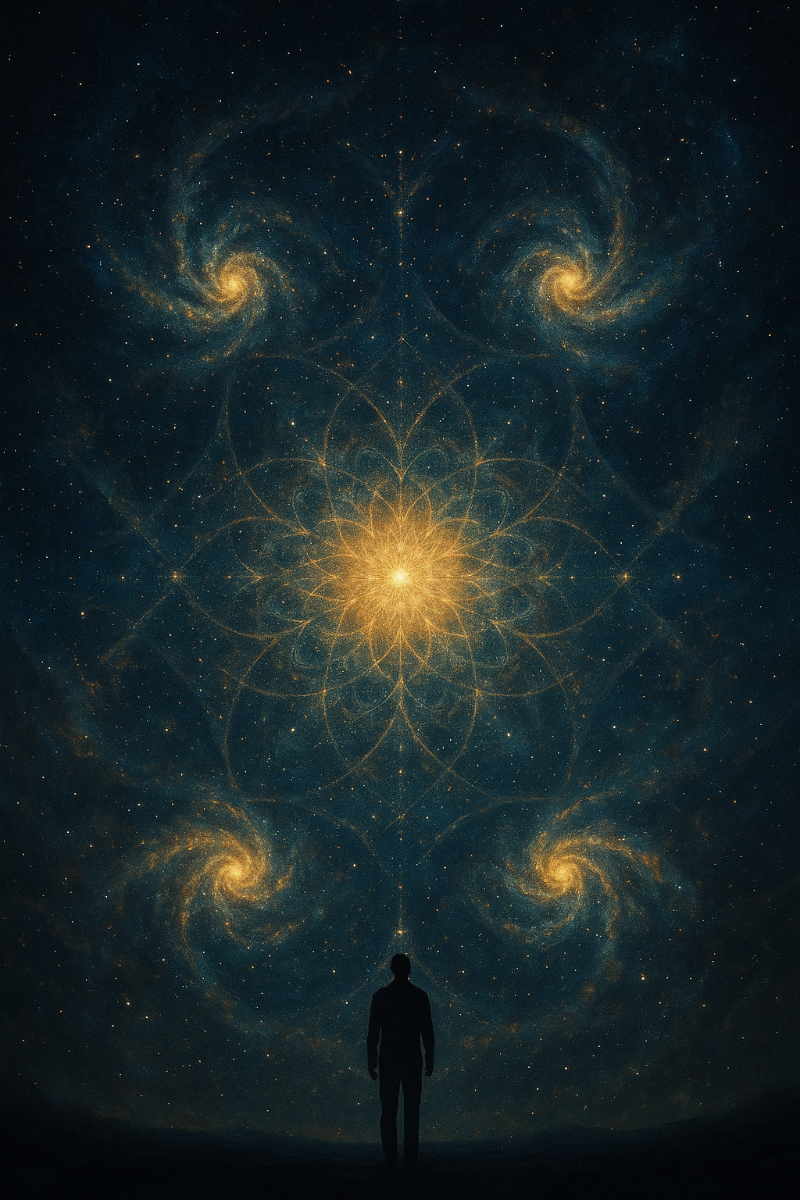
One of the oldest questions humanity asks is simple:
If God exists, why doesn’t He take away suffering?
It’s a fair question. We look around at the pain in the world — wars, injustice, heartbreak, loss — and it’s natural to wonder why a loving God would let any of it stand.
But what if chaos isn’t a flaw in the system?
What if it’s the very forge in which we’re made?
The Nature of God and the Design of Chaos
I tend to think of God as Love itself — not a sentimental emotion or moral abstraction, but the very structure of existence. Love is the intelligence that organizes the universe, the current that draws all things toward connection, harmony, and growth.
Where science sees pattern and law, I see Love’s logic — an intelligence vast enough to set galaxies into motion, yet intimate enough to whisper meaning into the human heart.
Love is both the blueprint and the builder.
It is what gives form to chaos and purpose to creation.
If God is Love, then chaos is not proof of His absence — it’s part of His language. Every storm, every collapse, every loss is an act of reordering. It breaks apart our illusions and reshapes our understanding. Chaos isn’t destruction — it’s the turning of a divine wheel, the rearranging of reality to bring about something new.
God is not merely watching creation unfold; God is creation unfolding.
He is the consciousness expanding through every act of growth, every moment of compassion, every spark of awareness.
Love is the intelligence that gives the universe its pattern, and intelligence is Love’s way of knowing itself.
Freedom, Love, and the Sacred Risk
If God is both Love and Intelligence — the conscious architecture of creation — then freedom isn’t an accident of design. It’s essential to it.
Love cannot exist without freedom.
And intelligence cannot evolve without error.
Control might produce order, but it kills meaning. It removes discovery, risk, and the capacity to choose. A love that is forced ceases to be love — it becomes slavery, obedience without soul.
True love demands freedom — the freedom to reject, to doubt, to fall, and to return again by choice. Only through that risk can love remain alive, and only through freedom can consciousness continue to grow.
For love to be real, it must be chosen. And for choice to exist, there must be contrast — light and darkness, creation and chaos, truth and illusion.
Freedom gives us the power to move toward or away from God, toward harmony or into disorder. That freedom is the sacred risk written into existence — the risk that gives life its meaning.
Without it, there would be no discovery, no creativity, no evolution of soul. The same intelligence that carved the stars also carved into us the ability to choose — to love willingly, to stumble honestly, and to rise again through grace.
The Dual Kaleidoscope: God’s Mirror in the Soul
At the center of everything is God — not as a distant judge, but as the living intelligence flowing through all things.
That intelligence works through pattern and chaos, form and dissolution, expansion and return. Creation itself is a cosmic kaleidoscope — endlessly turning, scattering its fragments into new designs.
Every shift looks like disorder from up close.
But from a wider view, you begin to see: every turn forms a pattern.
Chaos and order are not enemies. They are dance partners — divine contrasts that create beauty through movement.
Now look closer — because this kaleidoscope doesn’t just exist outside of us.
It exists within us too.
The Inner Kaleidoscope: Jung’s Shadow and the Mirror of God
Carl Jung called the shadow self the unknown dark side of our personality — the place where we bury the parts of ourselves we’re unwilling to face. It holds not only our anger, jealousy, fear, and shame, but also our hidden strength, creativity, and instinctual wisdom.
In repressing the shadow, we repress our wholeness. We fragment the self. And in doing so, we recreate the very chaos we fear — not out there in the world, but inside our own hearts.
The shadow is our inner chaos — the storm that mirrors the disorder of the universe. But, like outer chaos, it isn’t our enemy. It is the field where growth takes place.
To integrate the shadow is to participate in creation itself — to bring light into the dark corners of the soul. It’s the same pattern God enacts on the cosmic scale: taking disorder and turning it into order, transforming what was hidden into beauty and truth.
This is what Jung called individuation — the process of becoming whole by reconciling what we reject. And it mirrors what faith traditions call sanctification, enlightenment, or salvation: the reuniting of the divided self with the divine whole.
When we meet our own shadow with love instead of shame, we begin to see that God is not only in the heavens — He is within.
The universe is God discovering Himself through creation.
And we are God discovering Himself through awareness.
The meeting point — where the outer and inner kaleidoscopes align — is Love.
Because Love is what draws the fragments toward wholeness.
Chaos, the Shadow, and the Choice of Love
Every time we encounter chaos — whether in the world or within — we’re being asked the same question: Will you resist reality, or will you work with it?
Ego resists. It clings to control. It blames, denies, deflects.
Purpose accepts. It learns. It transforms.
Chaos in the outer world shakes our structures.
Chaos in the inner world shakes our identity.
Both are necessary. Both are invitations to evolve.
When we reject the shadow, it projects outward — we start seeing in others what we refuse to face in ourselves. But when we turn inward with love, the projection dissolves.
We find that what looked like the devil in others was a wound in us waiting to be healed.
To integrate the shadow is not to destroy it, but to redeem it.
To turn what once caused shame into strength.
To let our inner chaos become fuel for wisdom, empathy, and creation.
This is the inner mirror of divine order — the process by which God reclaims His image within the human soul.
God in the Mess
Most of us picture God as a caretaker meant to clean up the mess.
But what if God’s presence is in the mess?
Think about your own life. The moments that shaped you weren’t peaceful.
They were the nights you didn’t think you’d survive. The heartbreaks that broke you open. The failures that forced you to face who you were becoming.
Those weren’t punishments — they were invitations.
Moments where Love turned the kaleidoscope inside you.
Chaos forces us to confront the question:
Now that everything else has fallen away — who will I choose to be?
And God, being Love, will never force that answer.
Because forced love isn’t love at all.
Free Will and the Reality of Love
We say we want a world without suffering.
But imagine what that would mean.
A world without betrayal would erase the possibility of trust.
A world without loss would erase the depth of love.
A world without wrong choices would erase the freedom to choose right.
If God removed every trace of darkness, He would also remove the possibility of love.
Because without choice, love becomes control — and control is the death of love.
The risk of freedom is the price of creation.
But it’s also what makes life sacred.
Every act of faith, every moment of forgiveness, every time we choose love despite the pain — these are the moments where creation continues through us.
The Lesson of Job
The ancient story of Job captures this tension between love, chaos, and choice.
Job had everything — family, health, wealth, and honor — and in what felt like an instant, he lost it all. His children died. His body failed. His fortune vanished.
But chaos didn’t arrive without permission. The “adversary” — literally translated as the tester — could only act with God’s consent. Chaos wasn’t rebellion. It was refinement.
The test wasn’t about how much Job could endure — it was whether Job would still choose love when all comfort was gone.
He questioned. He cursed the day he was born. He wrestled with God Himself.
But in that wrestling, he met God anew — not as an idea, but as presence.
Faith born of comfort is conditional.
Faith born of chaos is eternal.
Job’s story reminds us: chaos isn’t evidence of God’s absence.
It’s where faith becomes real.
Why Darkness Must Exist
Darkness is uncomfortable, but essential.
Without night, we can’t see the stars.
Without storms, we can’t value the calm.
Without resistance, we can’t grow strong.
Darkness is not proof of God’s absence — it’s the backdrop against which love becomes visible.
When we choose light while standing in shadow, when we choose compassion over bitterness, faith over fear — that choice refines us.
That is creation recognizing itself through us.
The shadow is the same truth on a smaller scale.
The darkness in us is not meant to be erased, but integrated — transformed by awareness into wisdom.
The light needs the dark to reveal its meaning.
And love — real love — holds them both.
Chaos as the Crucible
Chaos does not come to destroy us. It comes to shape us.
Like fire refines metal, chaos burns away the weak and false in us. It exposes our motives, humbles our pride, and clarifies what truly matters.
This is why the Stoics taught that obstacles are not detours — they are the way.
Marcus Aurelius wrote: “The impediment to action advances action. What stands in the way becomes the way.”
Chaos serves that same divine purpose.
It forces us to get honest, creative, resilient.
It pulls us from survival into awareness.
Some people break under chaos.
Others harden into cynicism.
But those who meet chaos with love and humility are transformed.
They find peace not because the storm ends, but because they discover a center that chaos cannot touch.
That center is God — not above us, but within us.
Modern Chaos and the Daily Test
Our battles today wear modern faces:
Debt that feels inescapable.
Relationships fraying under silence and pride.
Addictions that whisper promises of escape.
Burnout that drains our sense of meaning.
Noise that tells us we’ll never be enough.
The forms change, but the lesson remains.
Every day, we’re asked: Will we meet this with ego, or with love?
The Balance of Chaos and Order
Creation breathes in patterns of chaos and order — destruction and renewal, birth and decay, the inhale and exhale of divine design.
Too much order and life stagnates.
Too much chaos and it collapses.
Growth happens in between — in that sacred tension where both refine each other.
Every challenge we face invites us into that balance.
The more we resist, the louder the lesson becomes.
The more we align, the more graceful the pattern appears.
This is God’s kaleidoscope — both cosmic and internal.
Every turn shatters and remakes us.
Every rotation draws us closer to wholeness.
Walking with Chaos and Order
So how do we live in rhythm with this divine pattern?
- Accept chaos as sacred.
Don’t ask why me? — ask what is this teaching me? - Remember that choice is holy.
Every moment of resistance is a fork in the road. Ego pulls one way. Love pulls another. - Anchor in faith.
Faith isn’t denial. It’s trust — the quiet knowing that even the breaking has meaning. - Integrate your shadow.
Notice what you judge most in others. It may be the part of yourself still waiting to be loved. - Let pain deepen compassion.
Suffering can harden or humanize. Let it open your heart instead of closing it. - Transform obstacles into growth.
Remember: the obstacle is the way. Let each struggle teach you resilience. - Seek peace through alignment, not avoidance.
God’s presence isn’t found by escaping the storm, but by standing still within it.
The Making of Man
Chaos is not a glitch in creation.
It’s the crucible in which humanity is forged.
We are not made in spite of suffering — we are made through it.
The question is never whether chaos will come.
It’s whether we’ll meet it with ego, or with love.
God allows chaos not to punish us, but to grant us the dignity of choice.
And every time we choose love — internally or externally — we help creation remember itself.
The making of man is not the pursuit of a painless life.
It’s the slow creation of a being who can hold both light and shadow — and still choose the light.
Closing Reflection
You don’t need to wait for peace to find you.
Peace begins the moment you choose love within the storm.
This week, notice the chaos in your life — inside or out.
Don’t ask why is this happening?
Ask what is this revealing in me?
Then choose.
Ego or purpose.
Resentment or compassion.
Control or surrender.
Remember: the obstacle isn’t blocking your path.
The obstacle is your path.
That is the point.
That is the freedom.
That is the making of man.