
The Martyr and His Vanishing Act
October 27, 2025
Tricksters, Tyrants and Toxic Masculinity
January 10, 2026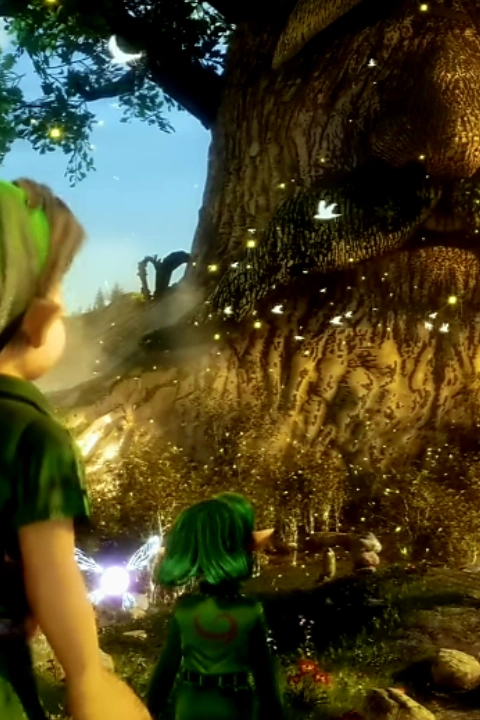
What can Fathers and sons learn from one of the greatest video games of all time?
The Legend of Zelda, Ocarina of Time is not only a personal favorite video game of mine, it has recently been named the highest rated video game of all time, according to metacritic. Once I heard that it had achieved this rating, I knew I needed to play it again as an adult, with my boys. Even if just for the nostalgia, I wanted to give it another run.
I still have vivid memories as a kid in the early 2000s, sitting around our little tube-tv-dvd-combo in my brother’s room working through the various dungeons and mysteries in Ocarina of Time. We couldn’t afford the game guide and didn’t have a computer at home, so asking for help on the internet was out of the question. I had many siblings and we, as a council, would talk through the tasks and each take our turns attempting to survive each challenge. It may sound silly to place so much importance on a video game, but it was a foundational moment of brotherhood. The puzzles and story gave us a direction to move in, as a team.
But maybe it was more than just the fun and challenge of the game that shaped us as young boys? After having studied various aspects of psychology, masculinity, history and narrative I’ve found that Ocarina of Time is so much more than just a cool game with a great story – it’s a near perfect archetypal model for development for young boys.
Boy Psychology – a Speed Run
There are many aspects of boy psychology that are not included in this discussion, here I mainly focus on archetypes – interpretations and understandings of archetypes and what they can tell us about ourselves. I’ll be focusing on the archetypal structure of boy psychology referenced in King, Warrior, Magician, Lover: Rediscovering the Archetypes of the Mature Masculine, written by Jungian analysts Robert Moore and Douglas Gillette.
Within their book they reference 4 primary masculine archetypes (King, Warrior, Magician, Lover) and their immature counterparts (Divine Child, Hero, Precocious Child, Oedipal Child). The book focuses on understanding these archetypes so you can progress through them.

I’ll be discussing each of these in detail, but it’s important to note that there’s a specific chronology to these archetypes. The typical boy experiences (and fulfills) them in this order:
- Divine Child
- Precocious Child
- Oedipal Child
- Hero
Knowing the Hero is the final archetype that a young boy will enter, implies that he enters it with the knowledge and experience of the previous three. Given this, I created a graphic that I think better aligns with both the journey of boys as well as the story we enter within Ocarina of Time:
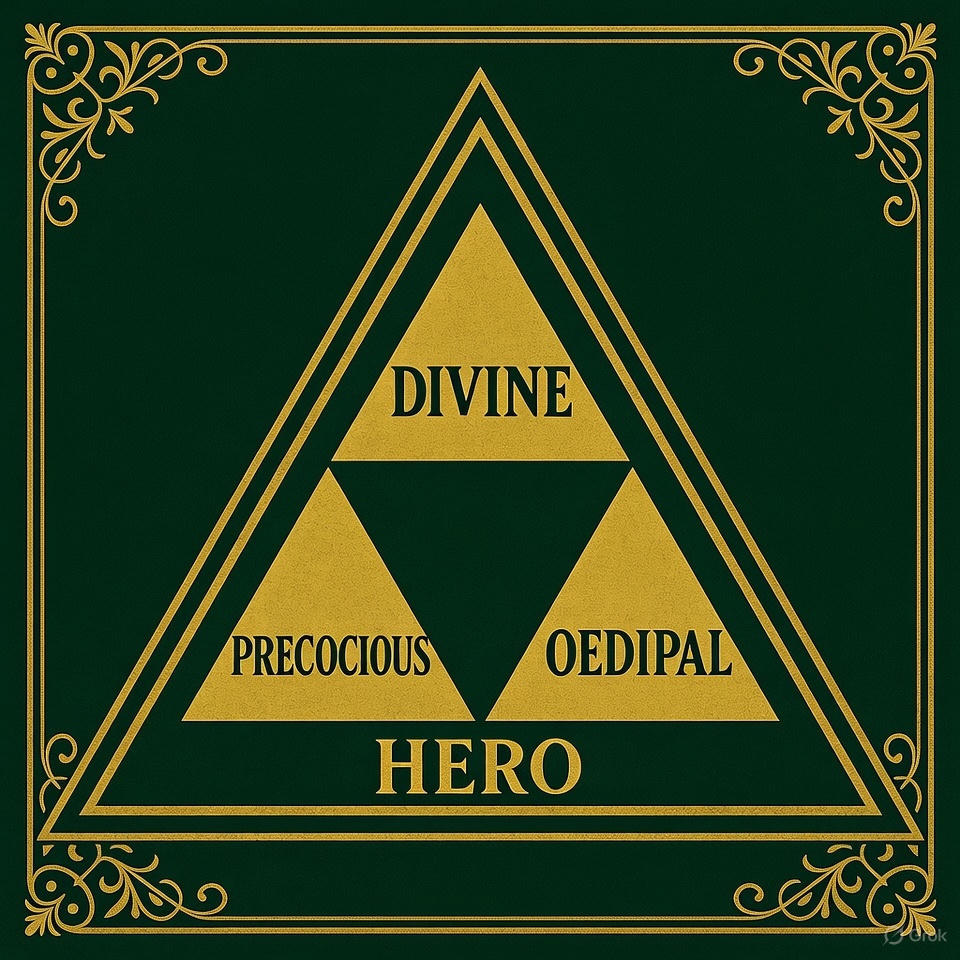
The construction of the three triangles of the Triforce creates in itself a fourth triangle, the Hero, as Link steps into the role carrying all the knowledge, magic and strength he gathered from journeying through each archetype.
First Phase – The Divine Child

The Divine Child archetype represents pure potential, the source of creativity, innocence, optimism and hope – so powerful it becomes, well, divine. This is the first phase children enter, as they are nothing but potential. Their parents see this and see the massive value a newly formed human can bring into this world. In stories and narratives throughout history the figures that embody this archetype are usually those rooted in religious history (Christ, Buddha) and follow patterns such as a story of a miraculous birth, a spiritual journey of being “saved” or transplanted from their homeland to a strange land, spiritual potential and an innate “goodness”. Within the Divine Child we see the potential for a righteous and powerful King, which is the archetypes mature form.
In Ocarina of Time, we get a prime example of this archetype in action. Young Link is a Hylian born in mystery and raised in his early years within the magical Kokiri forest. He is raised among the Kokiri, children of the forest who never age, in a forest protected by the magic of the Great Deku Tree. He is different from the others, and everyone knows it. One of the major differences is the fact that he, unlike all the other children, does not have a fairy companion.
How is Link fairing so far in this archetype?
- Stranger in a strange land
- Mysterious birth story
- Unlimited potential as he, unlike the Kokiri, can age, growing in size, strength and wisdom
Ladies and gentlemen, we have a Divine Child.
But what does this matter to us? Is this just a cool moment of pattern recognition, or is there something more to glean from it?
That all depends on what happens next.
The Deku Tree and The Summoning of the Hero
The Ocarina of Time begins with the Great Deku Tree, the Father of the Forest, calling forth Navi the fairy and directing her to wake Link and bring Link to him. There’s a lot we need to break down here to understand the importance .
Great Deku Tree – The symbolism here is incredible. Not only is The Great Deku Tree a manifest form of the King Archetype (a reflection in time of the Divine Child), the fact that he is a tree implies him to be an axis mundi, a connection between worlds. Trees are often interpreted as a bridge between the Celestial and Telestial.
Navi the Fairy – We find Navi as a mystical feminine force, that under the direction of the King wakens Link and guides him on his various adventures throughout Hyrule. She cannot die, and is with Link nearly all the entirety of the game (it’s no mistake she departs after the princess has been saved). She represents the anima, a source of renewal and feeling, intuition and soul. Powerful to note here that when you find other fairies in the game, they replenish your health. This divine or mystical feminine energy is an essential component to the masculine energies and a man cannot be whole without it operating in its proper function.
So let’s reframe what’s happening here. The King, the cosmic connection between Celestial and Telestial, with the help of Navi the Fairy (Divine Feminine) summons the Divine Child from a state of pure innocence and protection (a Garden of Eden, if you will) and calls him forth to become more than he is.
And what is the first task the Great Deku Tree? For Link to cure him of a curse, found within the Great Tree himself. Link ventures inside the Father of the forest to find an accursed parasitic monster, draining the life from the Tree. This is the “Rescue your father from the belly of the whale” Jordan Peterson moment, where Link uses his divine potential to start actuating in defense of the King of the forest. And when he breaks the curse on the Deku Tree, he is rewarded with critical knowledge and endowed with purpose when the Deku Tree uses his last moments to teach Link of the evil flooding the land and call him to travel to Hyrule to destroy it.
Link then receives the first of three mystical stones, the Kokiri’s Emerald. He is now more than just a Divine Child.
Fulfilling his portion of the Divine Child archetype is what breaks the curse, much like when you as a father watch your son grow old enough to no longer rely on you for survival – at this point your role of “father” will undergo a death and transformation of its own. At this point Link understands his divinity, and is moving forward to bring it into reality.
Fathers, at this point you should see yourself and your wife clearly through these symbols, and when doing so your role starts to become more clear. You are the force that calls your child out of the blissful innocence of childhood and into the action state of heroism. You do this whenever you play games with them, or throw your child into the air just a tad higher than they’re comfortable with. You teach them risk, and help them up when danger befalls them. You are responsible for taking a Divine Child by the hand walking them through the evolution into something more than just raw potential. Give them all your wisdom and experience so that after you are gone they can save the kingdom.
Your wife, with her divine connection to the child she created, will always be with her children as they grow, and it is her voice they will hear as a warning call to danger in perilous times. She will guide and be a source of nurturing and comfort, and her voice will compliment yours as you summon forth your children out of safety and into a fallen world.
In parts two and three we’ll dive deeper into the next phases, the Precocious Child and the Oedipal Child. I recommend that every father take some time to play this game with their sons, at the very least for the fun of gaming – but in hopes to understand more deeply what your role is to your children and how you can help them master their own Divine Potential and turn it into something amazing.
P.S.
It is by no mistake that, in order to encounter the Great Deku Tree, Link must first obtain a sword and shield. In religious context the sword typically symbolizes Truth, while the shield represents Faith. It grants even more power to this story that only after having acquired Truth (and the ability to wield it) and Faith can Link rescue the Tree from his curse. Therefore it is imperative that we equip our children with the same tools, so that one day they can transcend not only their own weaknesses but ours as well.